
The Goal
A data center brings investment and essential computing capacity, but it can also require land, power, water, utility upgrades, roads and other infrastructure, while affecting noise, traffic, viewsheds, resilience and community character. The Compact should make that bargain explicit: What does the project require from the community? What costs and impacts does it create? Who bears them? What lasting value remains in the host community? And what commitments govern the relationship over time?
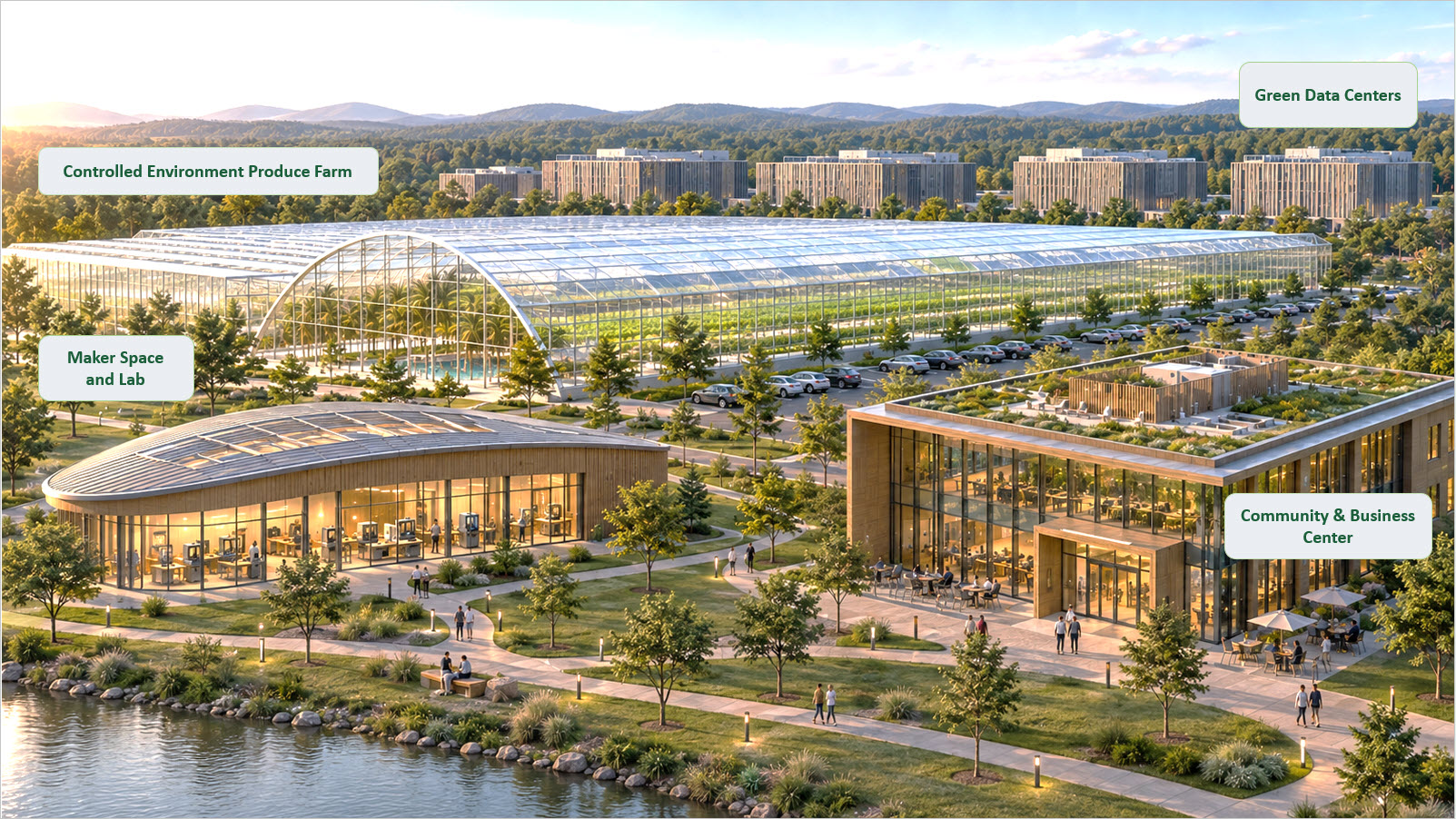
Greenplex is one possible case study, not the answer. Waste heat for controlled-environment agriculture, AI access, training, research, recreation, renewable-energy partnerships and other ideas illustrate what reciprocal value might look like. Different communities and different data centers will produce different answers.
One community benefit deserves particular attention: a token-free community AI area. A host community could negotiate for dedicated access to AI computing capacity that is not constrained by individual token costs. That capacity could become a shared civic and educational asset - available to high school students, colleges, teachers, researchers, entrepreneurs, local government and community organizations for training, experimentation and research. The concept is not simply free use of a commercial chatbot; it is local access to the productive capability of the AI infrastructure the community is hosting.
The immediate task, therefore, is not to sell a solution. It is to agree on the questions that need to be asked.
Questions That Need to Be Asked
1. What exactly is being proposed?
• What type of data center is being proposed, and what will it do?
• What is its initial scale, electrical load, land footprint and expected operating life?
• What are its expected water requirements and cooling architecture?
• What backup generation, fuel storage and other support systems will it require?
• What is the anticipated construction schedule and operating profile?
• What expansion is contemplated, and what could the site ultimately become?
2. What infrastructure will the project require - and who pays?
• What new generation, transmission, substations or distribution infrastructure is required because of the project?
• What roads, water, wastewater, communications, emergency-response or other public infrastructure must be added or upgraded?
• What are the direct and indirect costs of those additions?
• Which costs will be borne by the developer, utility, existing ratepayers, taxpayers or other parties?
• Can the project demonstrate that costs properly attributable to it are not being silently shifted to the existing community?
• What does ‘Pay Your Own Way’ mean for this specific project?
3. What does the community take on?
• What are the expected effects on electric rates, water availability and other constrained local resources?
• What are the likely noise, traffic, visual, environmental and land-use impacts?
• How close should a facility of this scale be to homes, schools, businesses or sensitive resources?
• What impacts can be engineered away? Which can be mitigated? Which may be unacceptable at this location?
• What resilience or security risks are created by the project or by concentration of critical infrastructure in the region?
• How will the project affect the character and future development pattern of the host community?
4. What lasting economic value stays in the community?
• What tax revenue will the project actually generate, and over what period?
• What construction and permanent jobs will be created, and how many are realistically local?
• What opportunities exist for local procurement and local businesses?
• What workforce development, apprenticeships or training could be connected to the project?
• What infrastructure improvements will have value to the community beyond the data center itself?
• How can the community participate in the economic value created rather than simply host the physical infrastructure?
5. What additional community value can be created?
• What resources, by-products or capabilities created by the facility are otherwise being wasted or underused?
• Can waste heat be economically reused for controlled-environment agriculture, district heating, industrial processes or other thermal loads?
• Can cooling capability or other physical infrastructure support recreation or another community use?
• Can AI computing access support local education, research, entrepreneurship or public institutions?
• Should the host community receive a dedicated token-free AI access area or allocation of computing capacity as part of the community-benefit package?
• Who should have access - high schools, community colleges, universities, teachers, students, researchers, entrepreneurs, local government and nonprofit organizations?
• Could the facility support hands-on AI education and workforce training so students and residents learn to use AI as a productive tool rather than merely consume AI services?
• Could colleges and research institutions use the community allocation for locally relevant research that might otherwise be constrained by computing or token costs?
• What governance, safety, privacy, eligibility and fair-use rules would be needed so the resource functions as a genuine community asset?
• Should the access commitment be defined as a measurable capacity or service level so that it remains meaningful as AI technology and pricing models change?
• Can the project support AI workforce training or other skills that create higher-value local jobs?
• Are there useful renewable-energy, grid-service, broadband or university partnerships?
• Which opportunities genuinely fit the engineering, economics and priorities of this particular community?
6. What does community consent mean in practice?
• When and how should the community participate - before siting and design are effectively fixed, or afterward?
• What information must be available for residents and local officials to make an informed judgment?
• What tradeoffs is the community willing to accept, and in return for what?
• Are there locations, scales or impacts the community considers unacceptable regardless of compensation?
• How should legitimate quality-of-life concerns be distinguished from misinformation or generalized fear?
• What would constitute a fair process as well as a fair economic bargain?
7. How should the relationship be governed over time?
• Which developer commitments should be measurable rather than aspirational?
• How will power, water, noise, traffic and other agreed performance measures be monitored and reported?
• What happens if the project expands or materially changes technology?
• When should the Compact be reviewed or renegotiated?
• What mechanisms should exist for accountability and dispute resolution?
• How do we ensure that commitments made during approval remain meaningful ten, twenty or thirty years later?
8. What larger strategic questions must be considered?
• How should the national need to build AI infrastructure rapidly be balanced with local community interests?
• Does geographic concentration of data centers create resilience or national-security risks that should influence siting?
• Which concerns are engineering problems, which are economic-allocation problems, which are community-consent problems, and which are narrative or trust problems?
• Where can better engineering solve a concern, and where is a negotiated tradeoff still required?
• Which community-benefit ideas can scale, and which are valuable precisely because they are local and project-specific?
The Proposed Outcome
The first objective should be modest: agree on the questions. If developers, utilities, public officials and community representatives can agree that these are the questions a serious proposal must answer, we have the beginnings of the Compact.
A particularly useful test question is: If a community is hosting the physical infrastructure that makes AI possible, should some defined portion of that capability be available to the community for education, training and research?
The answers will differ by project and by community. That is a feature, not a defect. The Compact would provide the common structure within which those different answers can be evaluated.
Frame the problem; do not prejudge the solution.