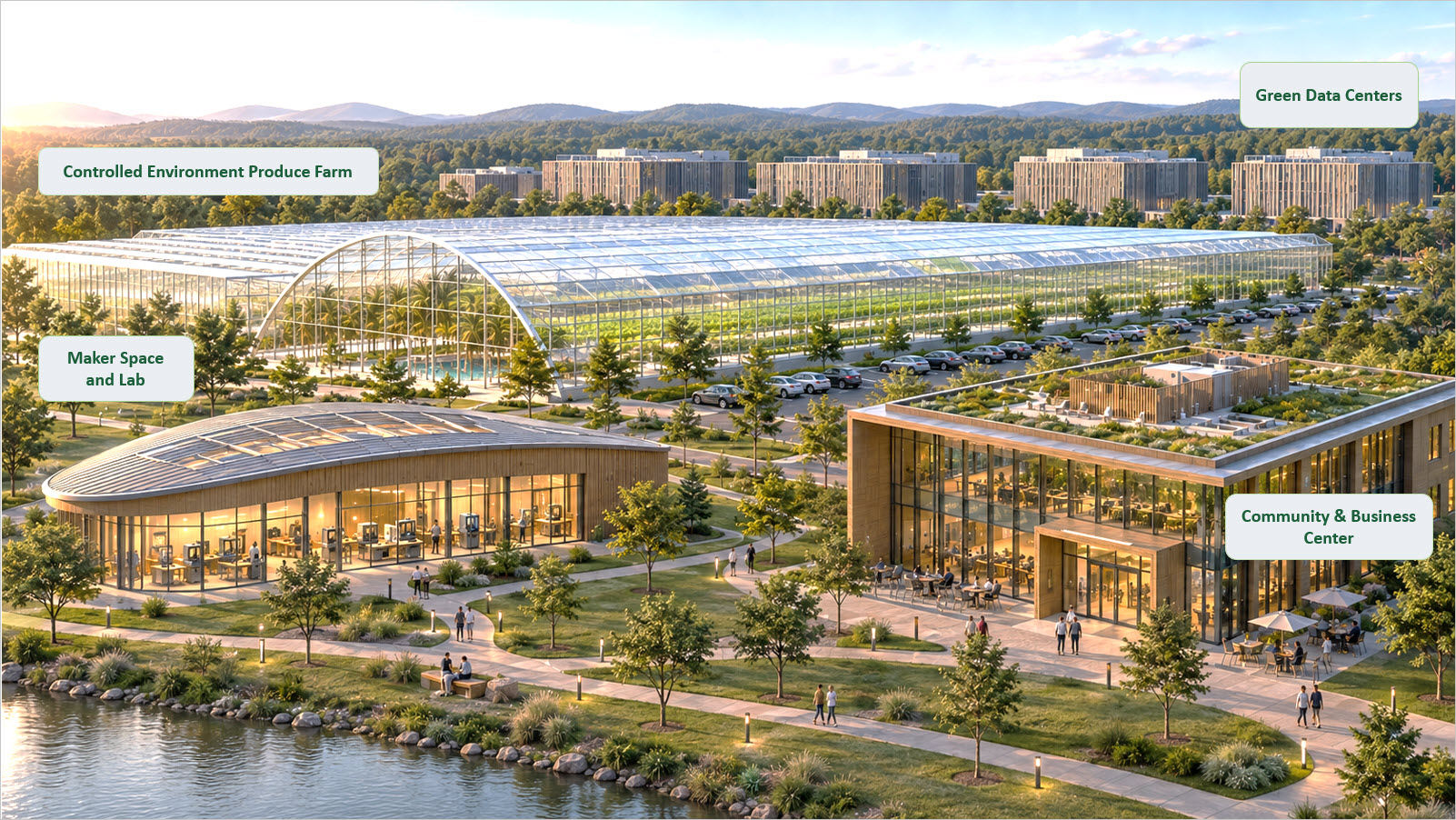
01
Liquid-cooled by necessity
AI racks at 50–150 kW cannot be air-cooled. Liquid cooling returns heat at 50–65 °C — hot enough for the farm to use directly.

That is not a sustainability story — it is an arbitrage. A ~100 MW liquid-cooled facility gives off roughly 54 MW of recoverable heat around the clock; a cold-climate greenhouse spends its largest controllable cost buying heat. Put them on one site and both sides of that trade improve — and GreenOS is the operating software that runs the trade.
Converts nearly all its power into heat — then pays to throw it away, in capital, in electricity, and in community goodwill.
Is a thermodynamic machine for turning heat into healthy food — and heat is one of the largest controllable costs in a cold-climate farm.
Heat and electricity flow from the data center to the farm; payments are tangible and intangible. Revenue from both sides is shared into the research & community center, which generates revenue of its own.
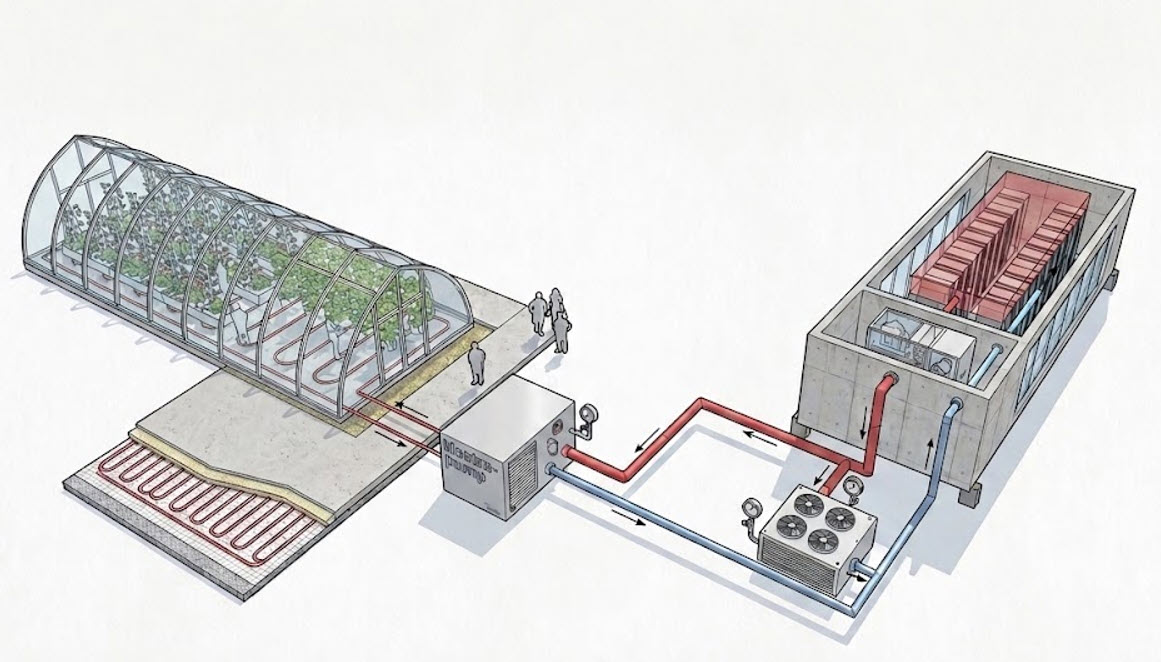
AI racks at 50–150 kW cannot be air-cooled. Liquid cooling returns heat at 50–65 °C — hot enough for the farm to use directly.
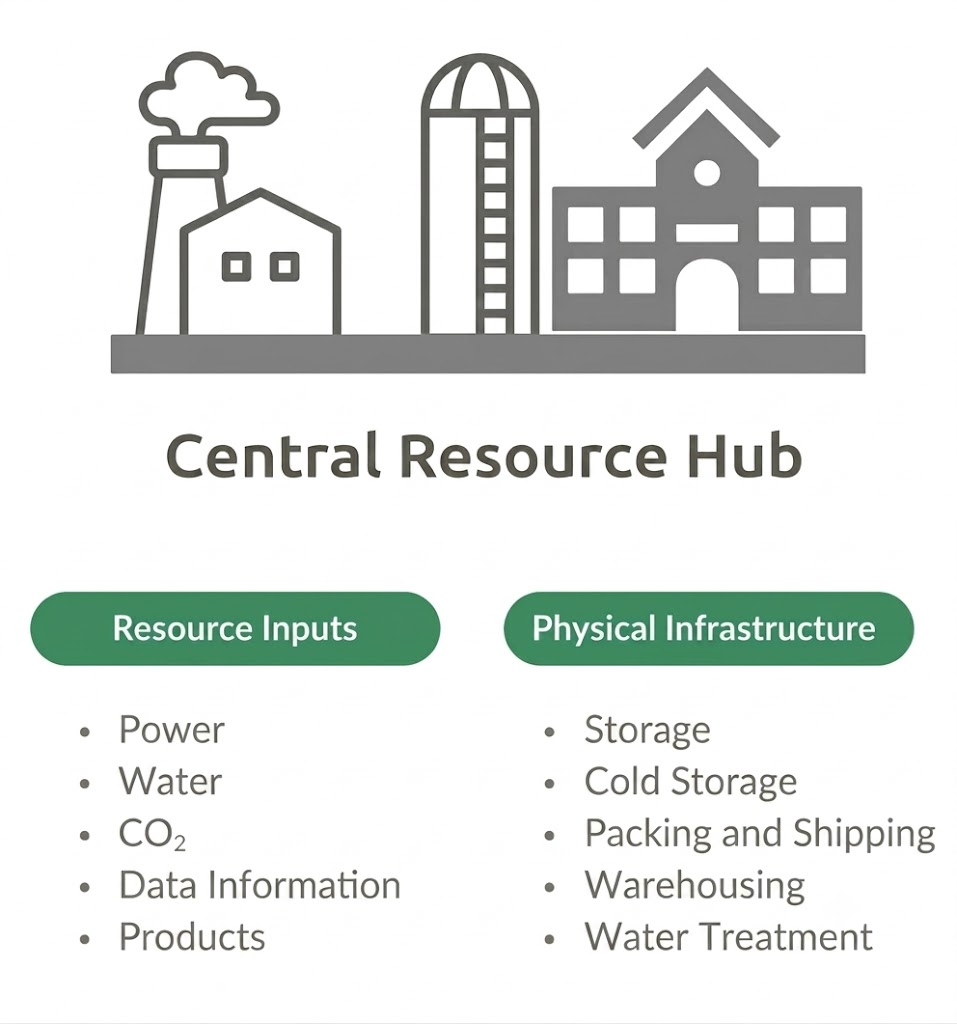
Grid interconnection, water treatment, roads, fiber and security — capital the farm would otherwise carry alone.
Communities increasingly say no — which is exactly where the other two legs of the campus create their value.
Climate, nutrient, labor and yield telemetry from every bay, reconciled nightly against actuals so the plan and the plant agree.
Heat-recovery scheduling, carbon accounting and shared-infrastructure metering between the data center and the greenhouse — the plumbing of the arbitrage.
Cost per pound, energy per pound, heat per degree-day — the numbers that make a CEA farm bankable.
Recovered heat, recovered CO₂ and one accounting boundary across both facilities — a credits narrative neither could write alone.
Blockheating pipes server heat into commercial greenhouses producing more than 88,000 lbs of tomatoes a month.
Stockholm’s district-heating market has bought data-center heat for years — enough to warm roughly 30,000 apartments.
Resource Innovation Institute benchmarks; state-level studies in Virginia, Pennsylvania and Ohio; Appalachian Regional Commission programs.
Our mission is to give communities a fair deal when data centers come to town and become a permanent aspect of the local landscape.
GreenPlex is a green living, playing, working campus built to answer the needs of the Citizens, a campus the community specifies. Organizationally, GreenPlex is comprised of formal partnerships between universities, communities, facilities developers, virtual energy providers, collaboration engineers and AI experts.
Let’s collaborate! Please get in touch:
The question isn’t whether communities should say yes or no to data centers. The question is why wait for data center developers to tell us what we’re getting.