Compute for the community. A welcome for the campus.
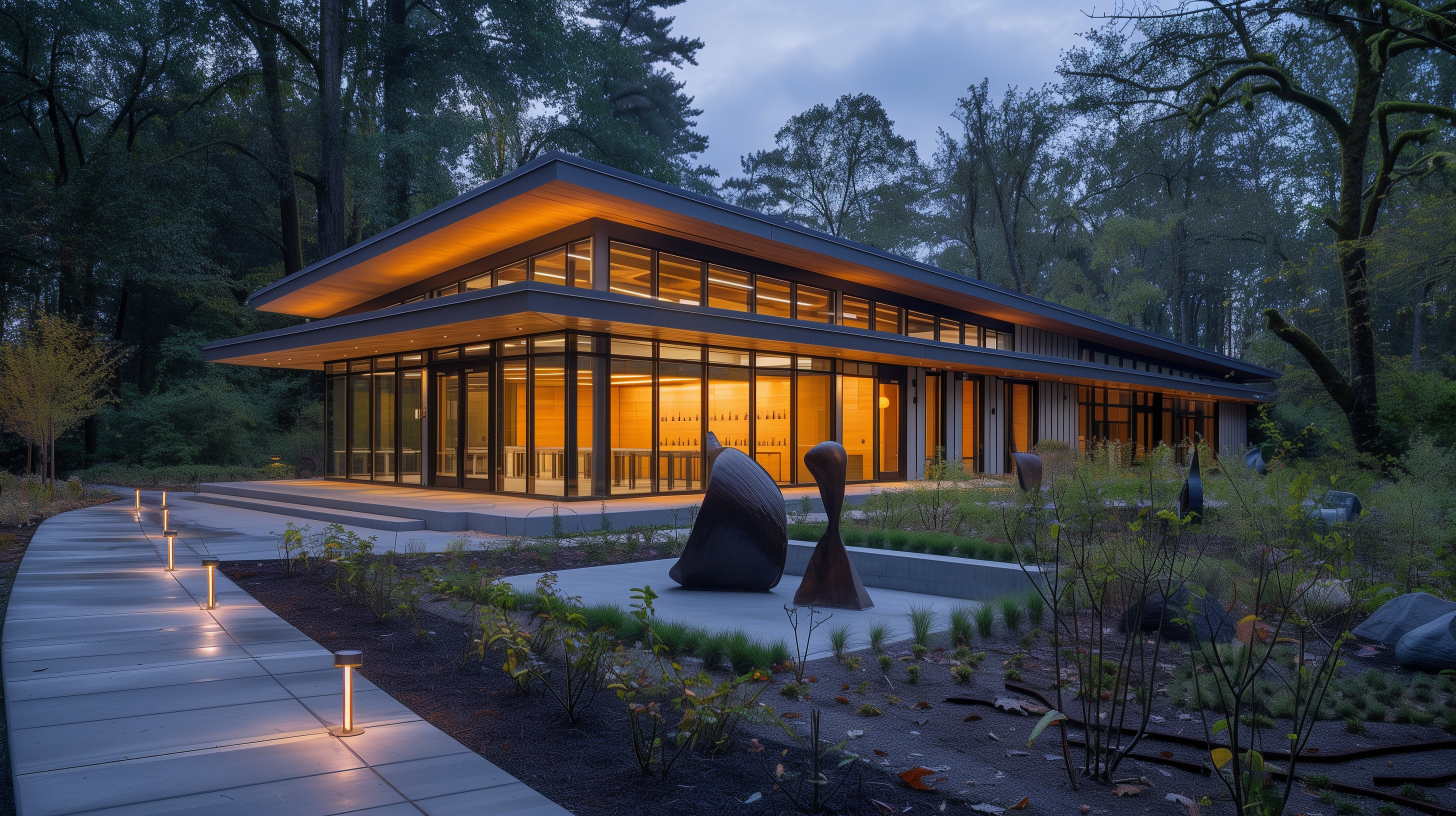
The Innovation Studio is the campus’s research, training and community hub — a research partner for regional universities, a route into skilled work, and the place where a data center stops being a windowless box and becomes a neighbor.
Communities facing data center developers should play offense.
Before the application
At GreenPlex, we have the engineering and planning know-how that ensures data centers are clean, quiet, non-disruptive and supportive of community life.
A genuinely green data center is not simply one that buys renewable electricity. It is a facility engineered so that power, cooling, water, heat, land, grid infrastructure, backup generation, acoustics, and computing efficiency are treated as one integrated system.
Important techniques include
Clean & Efficient Power
Low-carbon electricity, renewables, nuclear or geothermal where appropriate, high-efficiency transformers and UPS systems, and reduced electrical conversion losses.
Efficient Computing & Low PUE
Higher server utilization, virtualization, workload consolidation, power management, efficient CPUs/GPUs, and minimizing non-IT facility energy.
Advanced Cooling
Direct-to-chip liquid cooling, warm-water loops, free cooling, dry coolers, and reduced dependence on compressor-based chillers.
Water Conservation
Closed-loop cooling, minimal potable-water use, reclaimed and rainwater use, optimized cooling towers where required, and water-stress-aware WUE measurement.
Waste-Heat Recovery & Reuse
Capture server heat for greenhouses and controlled-environment agriculture, buildings, hot water, district heating, aquaculture, industrial processes, or thermal storage.
Grid Integration & Energy Storage
Microgrids, batteries, demand response, carbon-aware workload scheduling, peak shaving, load flexibility, and reducing stress on the regional electric grid.
Cleaner Backup Power
Reduce reliance on diesel generators through batteries, fuel cells, multiple utility feeds, microgrids, and lower-emission backup technologies.
Green Transmission & Electrical Infrastructure
Reuse existing substations and transmission corridors, selectively underground power lines, minimize new rights-of-way, and use SF₆-free switchgear where practical.
Noise & Community Protection
Low-noise fans and cooling equipment, acoustic barriers and berms, vibration isolation, interior mechanical-yard placement, and controls for low-frequency noise and infrasound.
Land, Ecology & Circular Materials
Preserve forests, wetlands and wildlife corridors; use green stormwater infrastructure, native landscaping and lower-impact sites; reduce heat-island effects, embodied carbon, refrigerant impacts, and electronic and material waste.
Understanding how high-density computing benefits from direct liquid cooling
It’s very important for communities to understand: data centers are a fast-moving field, with major improvements occurring at a continual rate. The nightmare stories you hear about noisy, disruptive data centers belching fumes and polluted water — that is not how well-designed data centers will operate going forward. Examples of recent improvements: water cooling and closed-loop HVAC, both very consequential design changes occurring in AI and cloud data centers.
Traditional architecture
Chip→Heat sink→Server air→Data hall air→CRAH / CRAC→Chilled water→Chiller→Cooling tower
Every transfer requires fans, pumps or compressors. Direct liquid cooling shortens that path:
Direct liquid cooling
Chip→Cold plate→Coolant→CDU→Facility water loop→Heat rejection / reuse
Direct-to-chip liquid cooling is now treated as a mainstream architecture for high-density AI and HPC systems: ASHRAE’s Technical Committee 9.9 publishes liquid-cooling guidelines for it, and energy and thermal efficiency is one of the ten topic areas in the PNNL/ASHRAE/NEMA AI Data Center Energy Performance Framework.
Water or coolant has dramatically higher volumetric heat capacity than air. The same quantity of heat can therefore be moved with modest hardware instead of brute force:
Liquid needs
Relatively small pipes
Moderate pump power
Rather than
Enormous air volumes
Very large fans
High static pressures
This can eliminate substantial server-fan and room-air-handling energy.
Data center technology through a “community” lens
For a next-generation green data center, these are the factors included in the GreenPlex framework:
01Minimize compute energy per unit of useful work.
02Direct-to-chip liquid cooling for high-density equipment.
03Warm-water operation with little or no compressor refrigeration.
04Closed-loop dry cooling, to approach zero consumptive cooling water.
05Recover the warm water for greenhouses, buildings or district heating.
06Use battery-backed microgrids and flexible computing to reduce grid stress.
07Minimize diesel generation.
08Use existing transmission and brownfield infrastructure where possible.
09Underground campus electrical distribution where the environmental or aesthetic benefit justifies it.
10Use SF₆-free switchgear where technically available.
11Engineer acoustic performance — especially low-frequency noise — before construction.
12Use green stormwater infrastructure and minimize impervious surfaces.
13Measure PUE, WUE, carbon, heat reuse and environmental impact publicly, rather than claiming “green” on the strength of one metric.
14Virtual power plants in the campus power schema — as Google has done, partnering with VPP providers to integrate household and alternative power sources.
Isolate heavy machinery using spring isolators & foam trenches
Establish industrial utility tariffs to protect residential ratepayers
* Deploy in-rack liquid cooling on AI GPU clusters to generate high-temperature waste heat, which transfers energy directly to the indoor greenhouse via passive liquid-to-liquid heat exchangers, while utilizing closed-loop dry coolers as a zero-water safety valve when agricultural heat demand is low.
So how could your community life be energized if a data center was accepted?
Every community already has the list: the things that stay in the queue year after year for want of funding.
Hands-on light manufacturing ‘maker space’ programs and digital competency internships for K–12 and university students.
Reskilling and workforce training with named partners and enrollment targets.
Gardening, arts & crafts and small business resources that no conventional local budget could ever carry.
Energy and heat put to work in a greenhouse, a district loop, local businesses.
Trails, parks, better broadband — a community center facility the town has wanted for twenty years.
A well-capitalized partner is arriving with the resources for precisely that list. GreenPlex helps the community think in advance about what to ask for — and that help extends to detailed site and facility requirement studies and penalty-based contractual agreement authoring.
01
AI next door
Inference and computing on campus — vision models, forecasting and research workloads a few hundred feet from the people using them.
02
Universities
A hub for AI-and-indoor-farming research with regional universities, with campus compute attached to it.
03
Economic engine
Skilled jobs, training programs, and the campus’s legible public face for the town that hosts it.
The GreenPlex dividend
Free and discounted AI tokens for the community and local business.
AI is expensive, and that cost is what keeps Main Street out of the AI economy. A data center on campus changes the arithmetic: local businesses, schools and civic organizations receive campus inference at little or no cost, with people on hand to help them apply it to real, everyday operations.
What the campus gives back
Communities · businesses
For communities
Inclusion in the AI era
A real stake in the AI economy, built right in the community.
Training & workforce development
Hands-on programs at the research & learning center.
AI literacy for everyone
K–12, universities and residents.
A solidly viable environment plan for the campus
Protect the air, water, landscape within and around the campus.
For businesses
Affordable AI services
Local compute and inference without hyperscaler pricing.
Tokens priced for Main Street
No big-tech budget required to put AI to work.
Practical adoption support
Help applying AI to real, everyday operations.
A hub for innovation, maker spaces, robotics workshops, etc
Give local businesses the knowledge and computing resources they need to move ahead.
Programs
Opening with the campus
Data-center operations track
Liquid cooling, power and facility systems — skills that transfer anywhere in the industry.
Small-business AI clinic
Walk-in help applying campus inference to payroll, scheduling, marketing and inventory.
K–12 AI & agriculture days
Field trips that end with students querying the farm’s own data.
University research residencies
Shared compute and a working farm as the instrument — published benchmarks as the output.
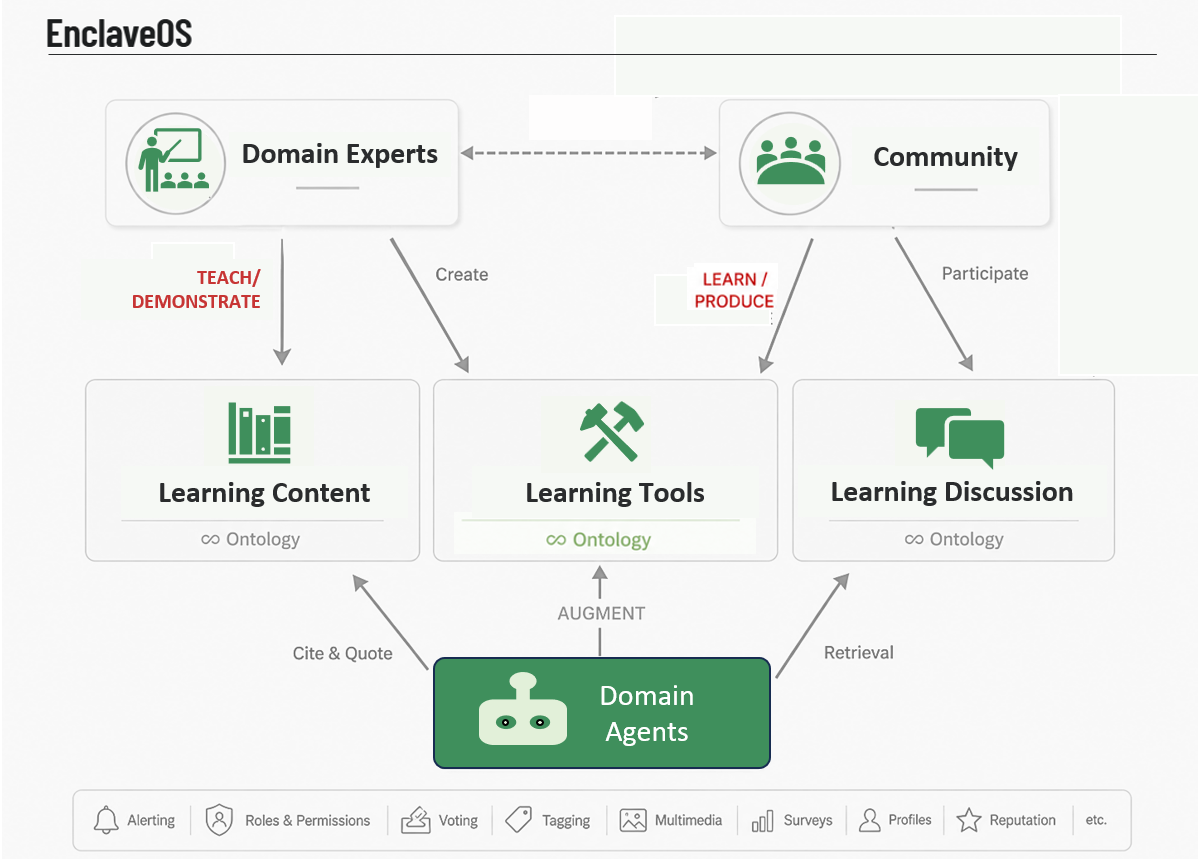
EnclaveOS — the operating software for community learning and research
Fig. 01 — EnclaveOS
Where GreenOS runs the farm, EnclaveOS runs the Innovation Studio. Human experts, the community and AI domain agents work on the same corpus: experts teach and align, the community learns and produces, and the agents cite, augment and retrieve across learning content, analytical tools and discussion threads — every artifact bound to a shared ontology.
EXPERTS TEACH & ALIGN
Domain experts author learning content and analytical tools, and keep the agents aligned to what is actually true on this campus.
COMMUNITY LEARNS & PRODUCES
Residents, students and local businesses participate in threads and projects — consuming knowledge and adding to it.
AI AGENTS AUGMENT
Domain-trained agents cite, quote, retrieve and augment — running on the data center next door, which is what makes them affordable.
From Citizens (a data center RFP)For Citizens (a green campus)
Our mission is to give communities a fair deal when data centers come to town and become a permanent aspect of the local landscape.
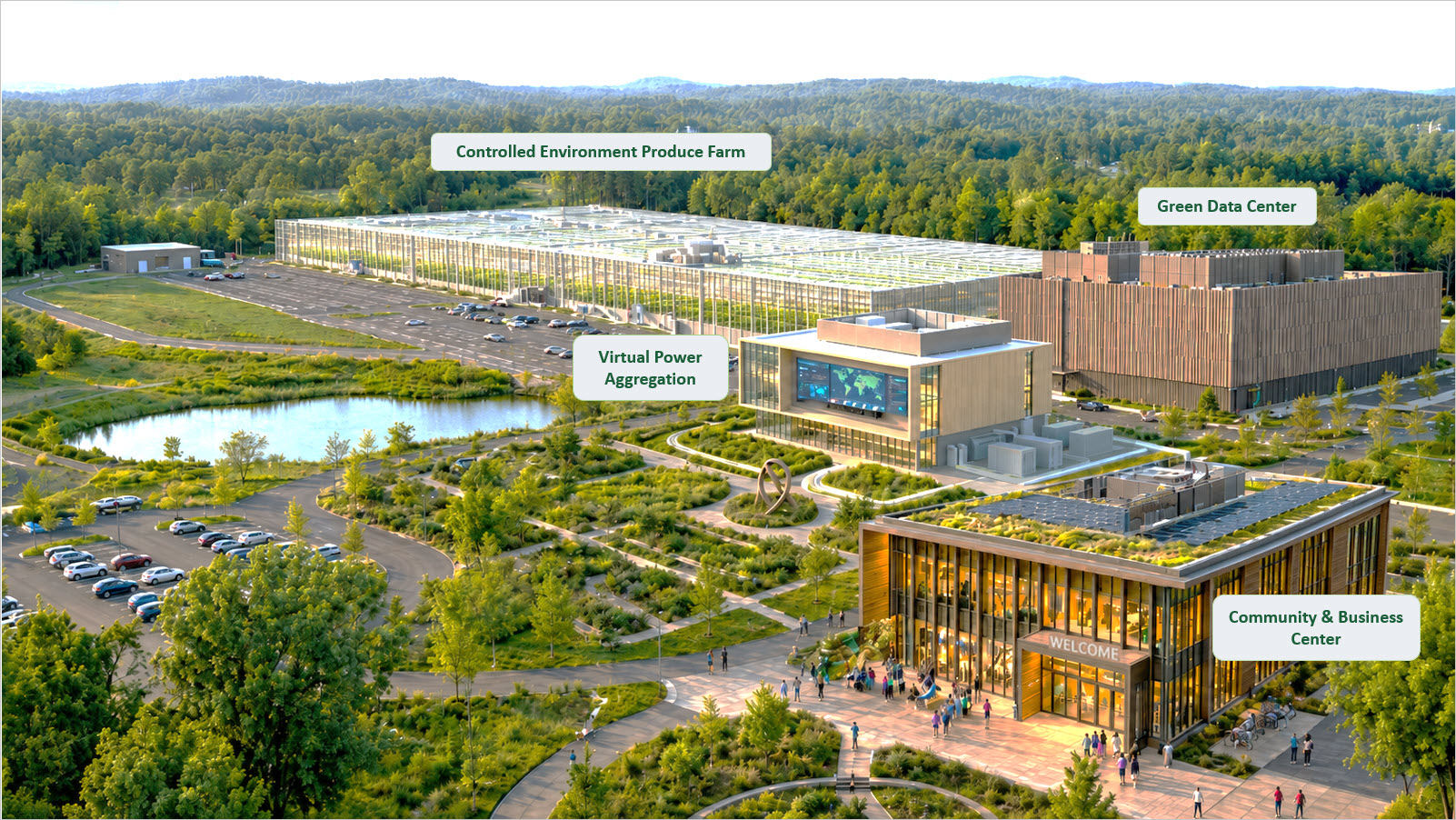
GreenPlex is a green living, playing, working campus built to answer the needs of the Citizens, a campus the community specifies. Organizationally, GreenPlex is comprised of formal partnerships between universities, communities, facilities developers, virtual energy providers, collaboration engineers and AI experts.
The question isn’t whether communities should say yes or no to data centers. The question is why wait for data center developers to tell us what we’re getting.