Before a developer writes a proposal, the community should write the RFP.
A Request for Proposal is an instrument issued before anyone bids. It sets out what the buyer requires, and every proposal that comes back is written to answer it. In a Citizen RFP, the community issues a request to the data center facility development industry.
Here is how these transactions usually work. A developer picks a site, designs the campus, sets its size, water draw and noise profile, decides what the community will receive, asks officials to sign non-disclosure agreements — and then arrives at a public hearing and asks permission. By then, the community’s principal instrument is refusal. That isn’t much of a negotiation. It is a veto process masquerading as one, and it reliably produces hearings past midnight and an upset constituency.
A Citizen RFP turns that sequence around. The community holds the one thing the project cannot proceed without — permission — so it is the party entitled to set the terms. It publishes its requirements first, names the lasting value it wants in return, and only then invites data center providers and hyperscalers to compete. The developer still writes the proposal; it simply writes it to the community’s specification instead of its own. Nothing about this is anti-development. It is the competitive procurement discipline a county already applies to a school or a bridge, applied to the largest industrial project it will ever host.
The same five decisions, reordered
Fig. 01 — the inversion
Nothing is added or removed. The decisions that bind a community for thirty years simply get made by the community, on the record, before the drawings are finished — instead of after, in front of a microphone.
How it works now
The developer defines the project, then the county defines value.
1Developer picks the siteSize, location and schedule are set
2Developer designs the campusWater draw, noise profile, buildings
3Developer decides the benefitsA pump station and some parkland
4Officials sign NDAsNo public record of what was traded
5Public hearingThe community’s only instrument is refusal
The Citizen RFP
The county defines value, then the developer defines the project.
Roughly $15 million toward a water pump station, $6 million for conservation and parks, and about 40 percent of the 427-acre site left as open space. Six weeks earlier the Planning Commission had recommended approval, six to one.
Everyone lost. The developer walked away from a year of application costs. The county got no tax base and no jobs. Residents stopped one project, which is not the same as getting something they wanted.
Lancaster, Pennsylvania · November 2025
$20M
agreed — and approved, six votes to one
Two standing funds of $10 million each, with named administrators. Payments tied to construction milestones. And a letter of credit the city can draw on directly if the developer misses one.
Less money, in absolute terms, than Hanover was offered. But it is an institution rather than an apology — and it is still standing after the ribbon-cutting.
Two communities, two packages of almost identical size, two opposite outcomes. The difference wasn’t the money. It was who wrote the terms, and whether those terms had any machinery behind them.
Communities don’t know what they are holding
Fig. 03 — the scarce input
Ask what a county brings to a data center deal and you will hear land. But land is abundant. What is scarce — and getting scarcer — is permission, delivered predictably and on schedule. Northern Virginia wholesale vacancy hit an all-time low of three-tenths of one percent in the first quarter of 2026, and industry analysts put zoning and entitlement among the binding constraints on expansion.
Hanover’s entire $21 million package was worth roughly five months of the tax revenue the same developer now projects from the same 900 megawatts, one county over in Goochland — about $1 billion over the first twenty years, or some $4 million a month once it runs. We have been trading the scarcest input in the supply chain for a pump station.
0.3%
Northern Virginia wholesale vacancy, Q1 2026 — an all-time low. Permission, not land, is the bottleneck.
CBRE
85%
Minimum share of the transmission and distribution costs Virginia’s new large-load rate class makes data centers cover — settled by a rate case, after the fact.
Virginia SCC, GS-5
+$16
Per month, the rise in a typical Dominion Energy residential bill for 2026. A cost that should have been assigned before the projects were built.
Inside Climate News
This is better for developers, too.
After Goochland residents made clear that water was the issue, the developer’s formal application committed to non-evaporative cooling it says cuts water use by roughly 95 percent — a redesign that landed about eight weeks later. It had already spent a year in Hanover discovering the same thing, at four votes to three.
Residents are telling developers what matters in the most expensive possible order: after the drawings are finished, in front of a microphone. A published set of requirements is cheaper for everyone — it moves the discovery to week zero, when a change still costs a redraw instead of a rezoning.
What a Citizen RFP specifies
Fig. 04 — the terms
Two halves, and the order matters. The first is a floor: the conditions under which the community is willing to host this at all. The second is the ask: the lasting value the community wants in exchange for the scarcest thing it owns. Set the floor, name the ask, then let developers compete. The four asks below are the headings; the schedule further down breaks them into the specific exchanges a bidder can be held to.
I. The floor — what the community will not trade
Noise
A decibel limit measured at the nearest residence, not at the developer’s fence line, with continuous monitoring the county can read.
Water
A hard annual cap, the source named, reuse and discharge disclosed, and a drought protocol that puts households ahead of cooling.
Grid cost
The load pays the transmission and distribution costs it causes. Nothing lands on residential bills, and the tariff is settled before the first foundation.
Tenant disclosure
What kind of tenant occupies the building, and who, before the doors open — not after.
Land and viewshed
Setbacks, open space, lighting, and a commitment on productive farmland that survives a change of ownership.
Default and decommissioning
A letter of credit or bond the community can actually draw on, and a funded plan for the end of the building’s life.
II. The ask — what lasting value looks like
Workforce
Training pipelines with named partners, enrollment targets and hiring commitments — not a scholarship fund and a press release.
Compute access
Reserved capacity for local schools, community colleges and small businesses, at a published rate.
Waste heat
Heat put to work locally — greenhouses, district loops, industrial process — rather than rejected to the air.
Governance
Standing funds with named administrators, payments tied to construction milestones, and public annual reporting.
The question put to bidders is not how much mitigation can we extract from you. It is what will you contribute to become our partner here?
The template — the exchange schedule
Fig. 05 — the three edges
The Citizen RFP is the first of three documents. It sets out, in plain language and before anyone files an application, what the community requires and what it expects in return. The two that follow translate those requirements into contractual interface language — the binding terms among the parties who become tenants on the campus.
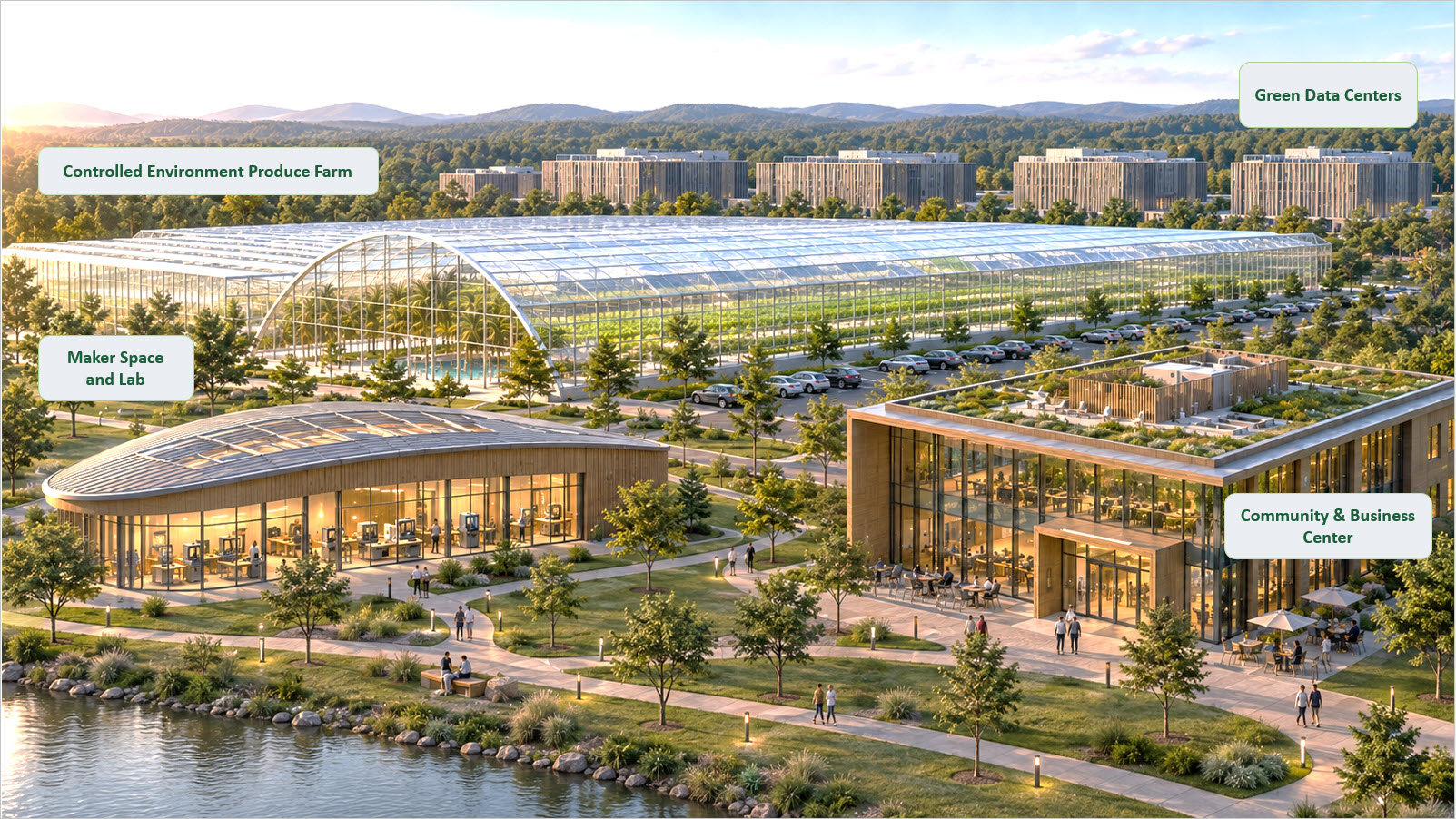
What follows is the heart of the template: a schedule of the exchanges a community can ask for, organised along the three edges of the campus. It is written for a GreenPlex-style campus — a farm, a community research and learning center, and a data center — but the structure transfers. Strike the rows that do not apply and the shape still holds.
What the farm owes the people who host it: food, ground to grow on, and open access to a working industrial process.
Compost
Free organic compost, up to a stated monthly volume, for community garden allotments on the campus.
Fresh produce
Free greens and produce for the community center cafeteria, up to a stated monthly volume.
K–12 learning
The farm floor open for class tours and embedded, for-credit learning experiences.
University research
Automation process data and operational artifacts published through the community center, where university researchers can run analytical and scientific work on a real production facility.
Maker space
Community and school maker-space users study the farm’s working technology and fabricate replacement parts and add-ons for it.
Supply chain
Small businesses working out of the Community Learning Center get a defined route into the CEA farm supply chain — resale, follow-on products, specialty crops.
Indoor allotments
A portion of the growing area reserved for community members, students and local businesses to run their own indoor projects.
Outdoor allotments
Ample outdoor gardening plots, with the water, soil, storage and tool resources that normally accompany them.
The edge that is usually empty. A data center sited next to a community should be a source of compute, bandwidth and skills — not just tax revenue and a fence.
AI tokens
A monthly allowance of free and/or discounted AI model tokens, so the community center and its remote programs can run education and AI-literacy work at real scale.
Network access
High-bandwidth internet for the community center over fiber the data center provides.
K–12 learning
The facility open for class tours and embedded learning experiences.
University research
Operations and automation data published through the community center for AI, energy and infrastructure research.
Maker space
Community and school maker-space users study the data center’s working technology and fabricate replacement parts and add-ons for it.
Supply chain
Where possible, small businesses working out of the Community Learning Center get a defined route into the data center supply chain — services, resale and follow-on products.
Computing resources
Free and/or discounted computer equipment for the community center.
Land & site works
The data center funds and prepares the ground for the community allotments and open space on campus, and maintains the shared site infrastructure serving them.
Every row above says what. The bidder says how much.
That is deliberate. The community names what it wants; developers compete on the size of the offer. But an offer only becomes an obligation when the RFP makes each bidder attach four things to it: a quantity — a number with a unit and a period, not “substantial” or “as available” — a named administrator who holds the commitment after the ribbon-cutting, a reporting cadence that says who sees the results and how often, and a remedy when a number is missed. A commitment with no remedy is an intention. That is the entire difference between Lancaster’s agreement and Hanover’s.
GreenPlex maintains this as a working document a county can adapt rather than draft from nothing — every requirement in procurement language, with what to ask for, how to measure it, what evidence a bidder must submit, and how the commitment is secured after approval. It is free to use, and it is not a GreenPlex sales document: a county that runs it and selects someone else has still run a better process.
Get the model RFP
The full template as an editable Word document — Part A, the exchange schedule, the enforceability rules and the evaluation criteria, with a response column for bidders to complete.
Adapting it for a live solicitation? Tell us the jurisdiction and where you are in the process — jmay@greenplex.ai.
From Citizens (a data center RFP)For Citizens (a green campus)
Our mission is to give communities a fair deal when data centers come to town and become a permanent aspect of the local landscape.
GreenPlex is a green living, playing, working campus built to answer the needs of the Citizens, a campus the community specifies. Organizationally, GreenPlex is comprised of formal partnerships between universities, communities, facilities developers, virtual energy providers, collaboration engineers and AI experts.
The question isn’t whether communities should say yes or no to data centers. The question is why wait for data center developers to tell us what we’re getting.