STEVE: I would like to ratchet this discussion up a bit and flesh out the concept that Pydantic can be a tool for negotiating and normalizing key concepts about business entities, business logic, workflows, in complex projects.
OPUS 4.7
Yes, Pydantic is increasingly used as exactly that: a mechanism for codifying business concepts, establishing contracts between teams, and normalizing how complex domains are represented across a codebase. In large Python projects, the Pydantic model file often becomes the single source of truth for what a Customer, Claim, or Order actually means.
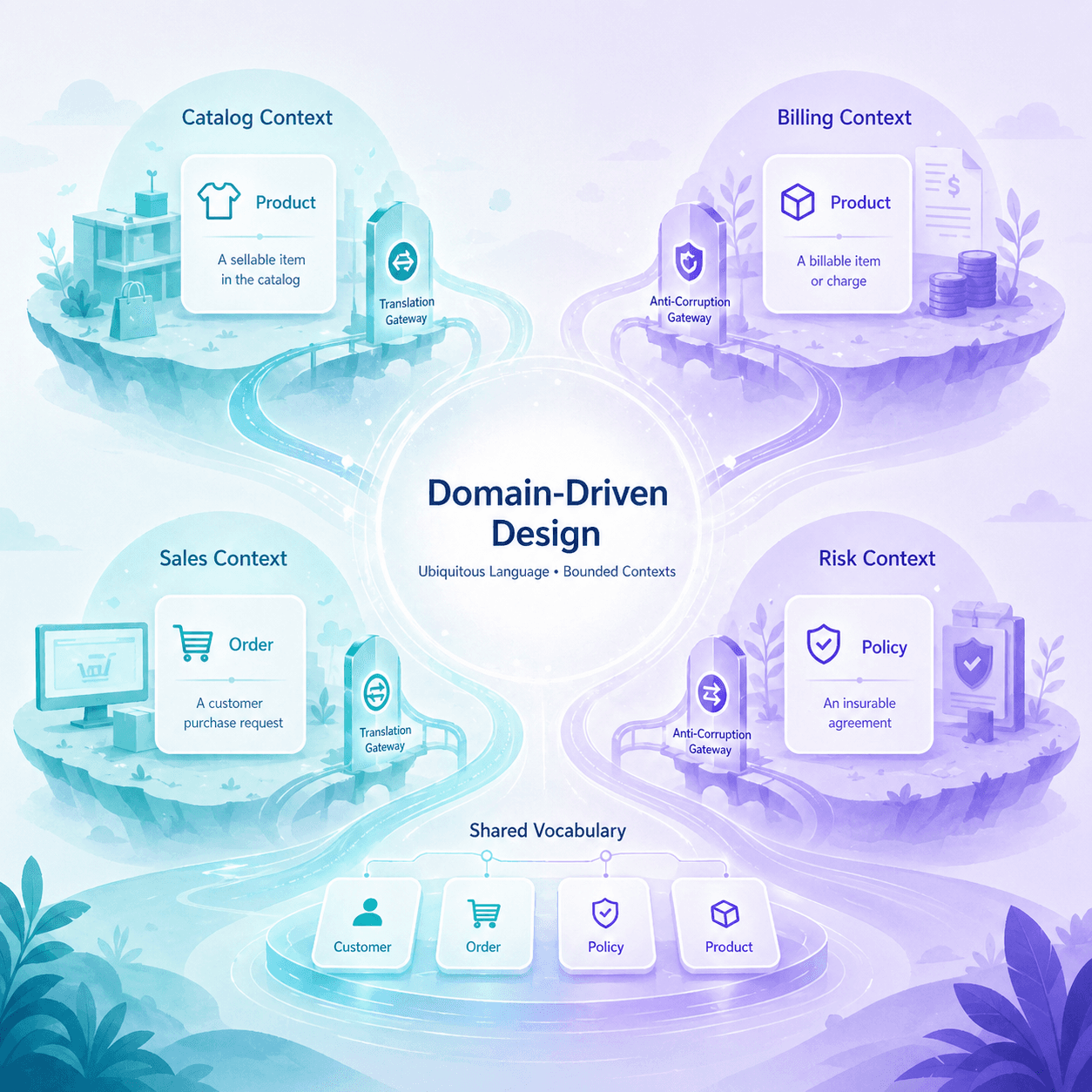
Ubiquitous Language in Code
Domain-Driven Design emphasizes a ubiquitous language—a rigorous, shared vocabulary between developers and domain experts that is reflected directly in the software. Pydantic models serve as the executable version of that vocabulary. When a team defines a Policy model with specific fields, constraints, and validators, they are not just describing data shapes; they are forcing implicit business assumptions to become explicit and reviewable. Teams use Pydantic BaseModel with frozen=True to implement immutable domain entities and value objects precisely because the model definition becomes the shared reference point that both technical and non-technical stakeholders can read.
Bounded Contexts and Contracts
In complex systems, the same word means different things in different parts of the business. A Product in a catalog context has different attributes and rules than a Product in a billing context. Rather than forcing one overloaded class to serve both domains, teams define separate Pydantic models for each bounded context. This mirrors the DDD concept of context mapping and anti-corruption layers, where each context owns its own model and translations happen at explicit boundaries. The Pydantic model acts as the contract—a typed, versioned schema that sets exact expectations for what data may enter or leave that context. When backend, frontend, and data engineering teams all import the same model definition, the schema file itself becomes the negotiated contract.
Encoding Business Logic and Workflows
Pydantic moves beyond simple type checking into business rule enforcement. Model-level validators can enforce cross-field constraints that represent real business logic, such as ensuring a transaction amount is positive or that a claim cannot be submitted without a policy number. For workflows, models can be designed to represent valid states of a finite state machine, where each stage is validated before the workflow advances. A pipeline might move through URL → WEB_PAGE → WEB_SUMMARY → DONE, with Pydantic validating each transition so that workers cannot skip steps or enter invalid states. Discriminated unions and nested models allow an entity like Order to have completely different required fields depending on whether it is in Draft, Submitted, or Fulfilled status.
The Social Function: Negotiation and Normalization
Perhaps the most underappreciated aspect is the social function. In a complex project, different teams often have divergent mental models of the same business entity. The act of creating a Pydantic model forces negotiation: "Does a Customer always have an email, or only after verification?" "Can user_id come from three different legacy formats?" When these decisions are captured in a centralized Pydantic definition—complete with AliasPath normalization to flatten disparate legacy structures—the model becomes the agreed-upon resolution. Future disagreements are deferred to the schema rather than reopened in meetings.
The Architectural Tension
There is a legitimate counter-argument here. Some practitioners argue that Pydantic should remain at application boundaries and that domain layers should stay pure, free from framework dependencies. The concern is that conflating the domain model with a serialization/validation framework creates coupling. However, Python's lack of native language-level tools for immutability, validation, and strict typing makes this purist stance expensive. Pragmatic teams often accept that the boundary between "domain model" and "data contract" is blurrier in Python than in Java or C#, and they use Pydantic intentionally to close that gap.
STEVE: Whether Pydantic is used inside an application for inter process communication or between applications via API, explain how the fields in Pydantic structured objects can be used for more than just data typing and class properties that get passed as parameters. In other words, those fields can stand for organizational and business issues, e.g., the authoritative nature of an object or the trust of an object or the priority of an object in some higher level value schema.
OPUS 4.7
Completed 8 steps
Yes, and this is where Pydantic becomes especially powerful in complex organizations. The fields are not merely type annotations; they can encode the semantic, authoritative, and governance context of the data itself.
Encoding Trust and Authority
You can model authority and provenance directly into the schema. A field like source_system: Literal["legacy_erp", "customer_portal", "manual_entry"] immediately tells downstream consumers where the data originated and how much to trust it. Teams add confidence_score: float = Field(ge=0.0, le=1.0) or is_canonical: bool alongside the business payload so that every object carries its own metadata about reliability. The Field() function accepts rich metadata—description, json_schema_extra, and custom annotations—that can document governance rules directly in the code where the schema is defined.
Priority and Value Schemas
Pydantic models routinely encode business priority. A task model might include priority: int = Field(description="Priority on a scale from 1 (high) to 5 (low)") with validators ensuring the value aligns with organizational SLA tiers. More importantly, models can enforce that priority logic structurally. A Claim model with a high-severity flag might require additional fields to be present, or a DataProduct model might include retention_class and access_classification fields that drive automated downstream behavior.
Data Contracts as Governance Tools
In enterprise contexts, Pydantic models evolve into data contracts. They can carry governance metadata—ownership, access rights, lineage, versioning, and contact points—directly alongside the schema. When team A publishes a Pydantic model for an Account and team B consumes it, the model is not just a packet structure; it is the negotiated, versioned agreement about what that entity means, who vouches for it, and under what conditions it is valid.
The Limits
The caveat is that Pydantic itself does not interpret "authority" or "trust" semantically; it validates types and constraints. It is up to the organization to agree that source_system="manual_entry" means lower trust, and to build workflows that respect those fields. Pydantic enforces the structure; the business logic gives that structure meaning.