Every business plan I have ever reviewed makes the same promise: here is the number. One revenue forecast. One EBITDA forecast. One valuation. It is precise, polished, and reassuring — and almost certainly wrong. Not because the model is flawed, but because the world refuses to cooperate. Crop yields drift. Construction schedules slip. Energy prices spike. Customers change their buying patterns. Markets move. Yet we continue to make multi-million-dollar decisions as though only one future exists.
Businesses do not live in one future. They live in many. While working with a controlled-environment agriculture company, I began asking a different question. Instead of asking what will happen, I asked what could happen. That change led to GreenOS, a decision platform that replaces a single forecast with hundreds of possible futures.
At first glance Figure 1 looks like another business chart. It is not. Every circle represents one complete ten-year future for the company, and each simulation begins with slightly different — but entirely realistic — assumptions for crop yield, retail channel mix, selling price, operating costs, and construction timing.
Run the model 150 times and something remarkable appears: not a forecast, but a probability distribution. Instead of asking what our valuation is, the conversation becomes what the odds are of achieving it.
Three Things the Simulations Revealed
First, probability is more valuable than precision. The median valuation was approximately $335 million, while roughly 70% of simulations exceeded $300 million and 21% exceeded $400 million.
Second, downside risk was smaller than expected. Even the weakest simulation remained profitable, at a valuation of roughly $176 million.
Third, the simulations identified which variables mattered most. Crop yield influenced EBITDA roughly twice as much as retail channel mix — shifting management’s focus from predicting the future to improving the odds.
This Isn’t Really About CEA Farming
Controlled environment agriculture happened to be the application. The principle applies equally to data centers, manufacturing, energy, healthcare, and infrastructure. Every capital-intensive organization operates under uncertainty, and planning around a distribution of possible futures provides a far richer understanding of opportunity and risk than planning around a single deterministic forecast.
Better Questions Lead to Better Decisions
Monte Carlo simulation has existed for decades. The mathematics are not new. The real innovation is changing the questions executives ask.
THE GREENOS PERSPECTIVE
When organizations stop debating whose forecast is correct and begin discussing which decisions improve the odds of success, planning becomes decision science.
Explore the GreenOS Knowledge Engine
This Insight is the executive overview. The complete methodology — the underlying financial model, simulation assumptions, econometric framework, sensitivity analysis, and supporting research — lives in the GreenOS Knowledge Engine under GreenOS Econometrics: From Forecasts to Probabilities. For what the same engine revealed about where CEA value is actually created, see GI-003, “CEA Value Is a Pricing Story.”
About GreenOS
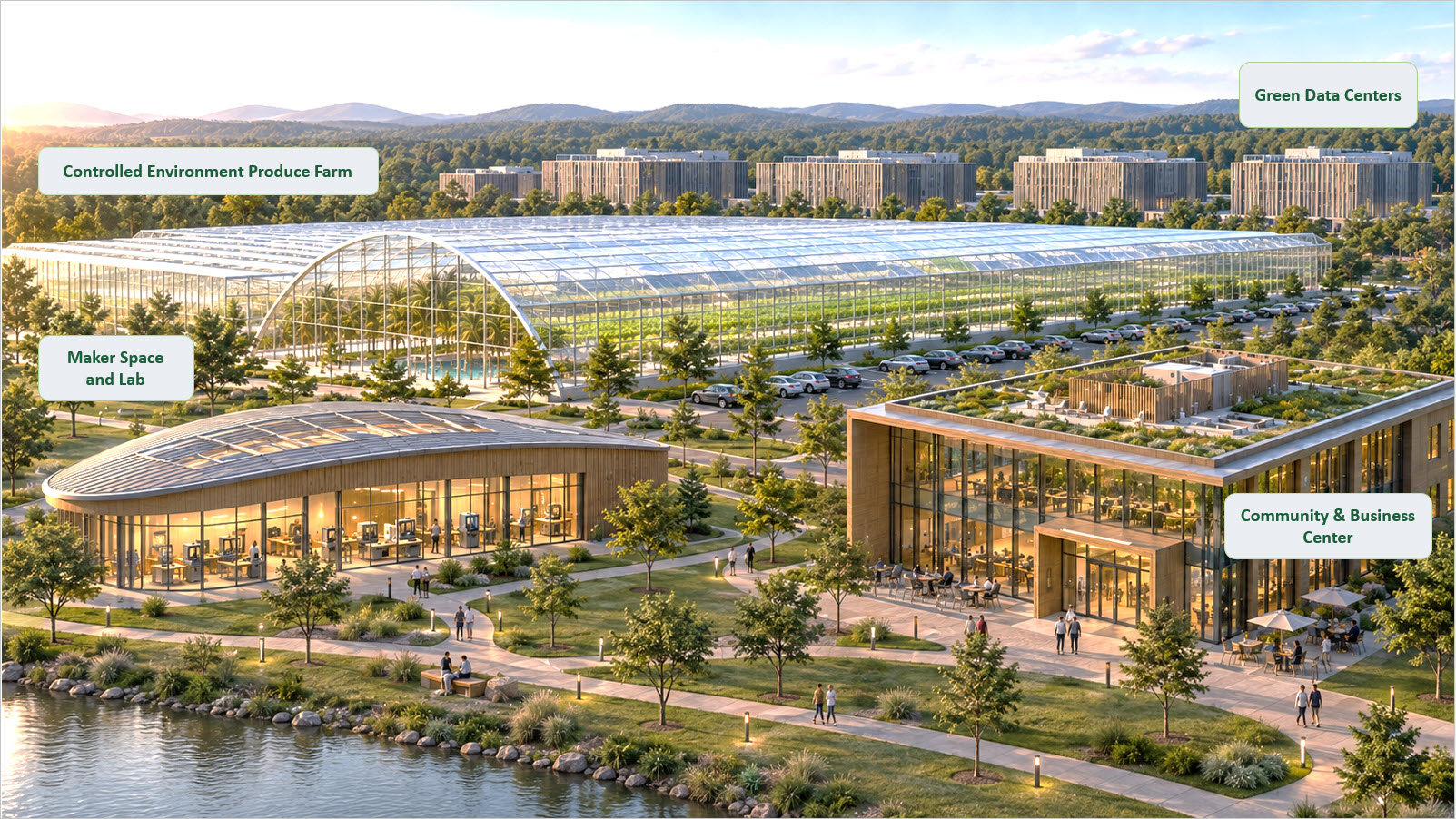
GreenOS is the software foundation for intelligent Controlled Environment Agriculture (CEA) farm management and a key component of the GreenPlex farm/data/community integration architecture.
GreenPlex Insights explores how digital twins, simulation, AI, and econometrics help organizations make better decisions under uncertainty.