In August, Loudoun County’s zoning enforcement staff stood in front of a town hall in Sterling and reported what months of resident complaints about a data center’s gas turbines had produced. Staff had gone out on 22 different dates and taken 132 noise readings. On four of those dates the readings came in above the county’s 55-decibel limit. None counted as a violation, because aircraft, traffic or children playing outside had contributed to each high reading.
Nobody in that room was acting in bad faith. The county did what its code asks: send someone with a meter, take a reading, decide whether it holds up. The operator said it had spent $15 million on noise reduction. And residents still described a high-pitched tone they could hear inside their homes, the kind of steady tonal noise that Prince William County rewrote its noise rules this year to address.
A spot check answers one question on one afternoon. Residents live with the noise every hour of every day.
That gap, between the reading and the experience, is where trust breaks down. Residents are asked to believe the applicant’s study before approval and the county’s spot checks after it. Neither is something they can check for themselves.
We already know how to fix this
This is not a new problem, and the fix is not a new idea. Two American industries with long histories of neighbor complaints already live with continuous, public, property-line monitoring.
- Airports. Residents near Los Angeles, John Wayne, Sacramento and dozens of other airports can open a public website, see every flight near their home, read the noise it registered at permanent monitoring terminals in their neighborhoods, and file a complaint tied to that exact event. At John Wayne, the public sees the same data the airport’s own noise office uses. Vancouver’s system exists because citizen groups demanded it.
- Refineries. Since 2018, every U.S. refinery has been required to monitor benzene continuously at its fenceline. The readings are published on a public EPA dashboard, and when the annual average at any monitor crosses the action level, the refinery must find the cause and fix it. The EPA says plainly why the data is public: so communities can oversee the facilities they live beside.
Notice what the refinery rule got right about the problem that sank Loudoun’s spot checks. A single reading can always be blamed on a passing truck or a gust of wind, so the rule doesn’t judge single readings. It judges the continuous record: the annual average at each monitor. One contaminated afternoon can’t rescue a facility that is too loud every night at 3 a.m., and one bad gust can’t condemn a facility that is quiet the rest of the year. Continuous monitoring doesn’t just take more readings. It changes what you can know.
So the question for a county weighing a data center is not whether round-the-clock public monitoring is reasonable. Planes and benzene already get it. The question is why a 500,000-square-foot industrial facility with turbines, chillers and diesel generators, placed 600 feet from homes for 25 years, should be the exception.
Community Sentry: the same idea, working for the neighbors
SentryOS is GreenPlex’s security and monitoring platform. Its public side is Community Sentry, and its promise fits in one line from our own materials: Sentry works for you, not the company.
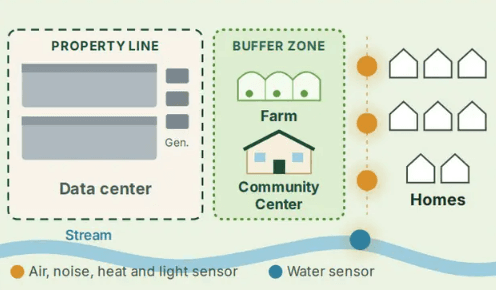
Engineers, architects and earth scientists lay out a sensor network around the campus: air, noise, heat and light sensors along the edge that faces homes, and a water sensor in the stream. The sensors run all day, every day, and the readings go to a dashboard any resident can open on a phone.
Where the sensors go. Sensors sit between the campus and the homes, with a water sensor in the stream. The phone is a sample screen. It watches the six things neighbors actually ask about: noise, down to the low hum you feel rather than hear; heat and humidity near homes; fumes from backup generators; water use, wells and streams; light, keeping the night sky dark; and generator runs, including the rule that is easiest to promise and hardest to police, no test runs at night.
- Measure. Sensors check all day, every day. The record at 3 a.m., with no planes overhead and no school buses on the road, shows what a Tuesday-afternoon spot check can’t.
- Alert. When a reading crosses a limit the community set, an alert goes off and the company is notified, with a deadline.
- Share. Everyone sees it on their phone. Residents, county staff and the operator work from one record instead of competing studies.
- Fix. The company pays to fix it. The alert, the response and the fix all stay on the record.
An operator that is keeping its commitments can show it every day. One that isn’t finds out early, while the fix is still cheap.
Who controls the monitor, and who pays for it
Here is the design choice we teased on LinkedIn, and it matters more than the sensors. At airports and refineries, the operator pays for the monitoring, and the arrangement still works for one reason: the operator doesn’t control the data. The FAA’s radar feeds the airport systems; the EPA publishes the refinery readings. Independence comes from who controls the monitor, not from whose name is on the invoice.
Community Sentry draws the same line, one step further. The community holds the subscription, one per community decision. It controls where the sensors go, what the limits are and who sees the readings. The monitor answers to the people it protects, which is the one thing an applicant-funded noise study can never claim. And a community doesn’t have to eat the cost: its Community Development Specification, the requirements it publishes before any application arrives, can require the developer to fund the monitoring the community controls.
Payer and controller are two different questions. Get the second one right and the first becomes a line item in the deal. One rule holds throughout: SentryOS takes no subscription from any party to a decision that is still pending.
From promise to proof
The readings don’t sit on their own. They feed the Verify stage of the Community Compact, the public record a county keeps of every commitment made at the vote. If an approval caps generator runs, limits noise at the property line or restricts water use, Community Sentry shows whether those promises are being kept for the 20 to 30 years the facility operates. It keeps showing it after the supervisors who voted have moved on, and after the site has been sold to an operator nobody in the county has met.
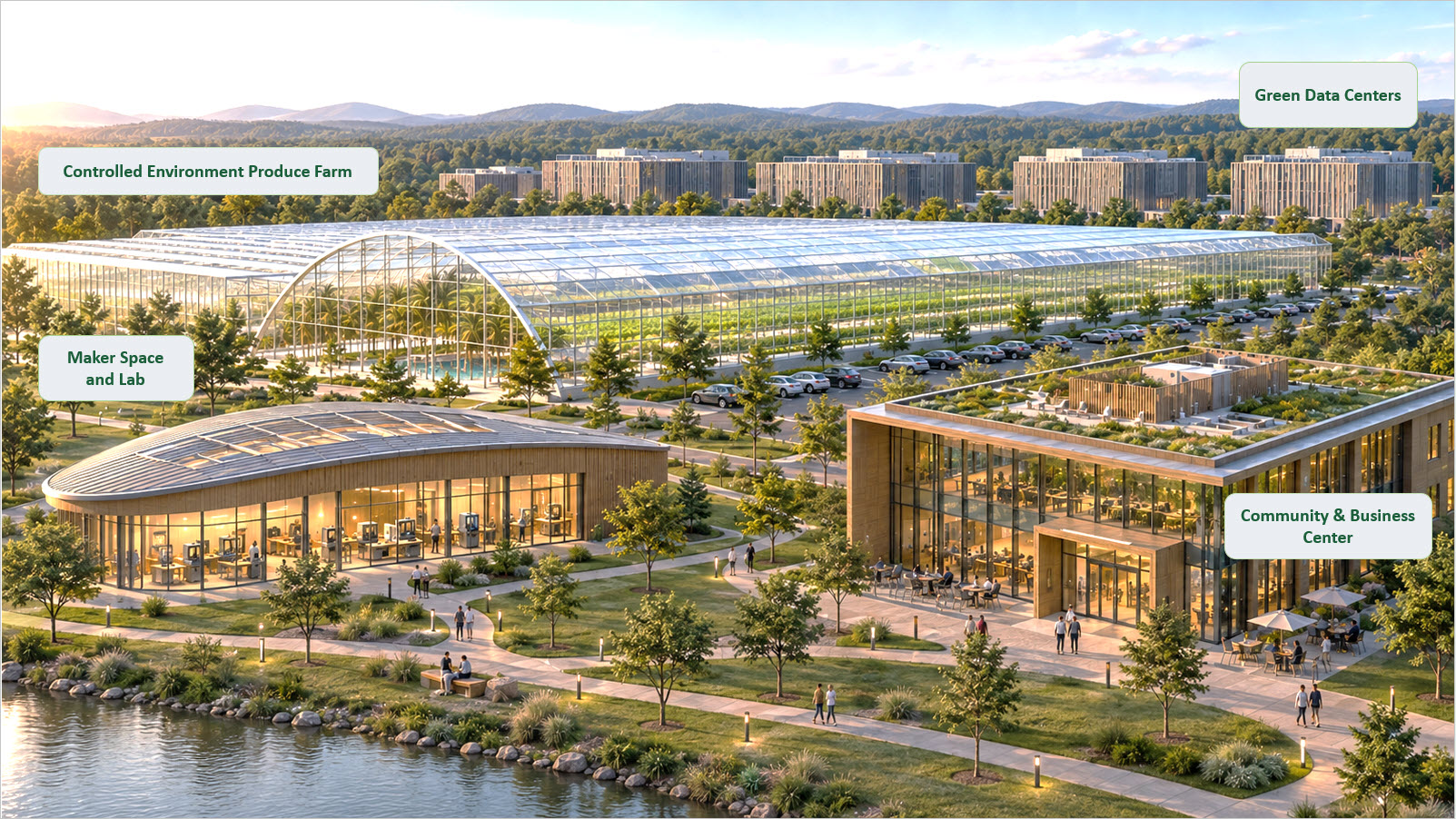
(Sentry’s other half serves the operators themselves: security and monitoring for the data center, the farm and the innovation center, including tracking the federal Known Exploited Vulnerabilities catalog against the control systems each site actually runs. That is a story for the operators’ side of the house; this page is about the community.)
Where Virginia is heading
Virginia’s Executive Order 22, signed in September, directs the Department of Environmental
Quality to develop noise rules for data centers and to review the cumulative effect of diesel backup generators. Rules set the limits, the way the EPA set the benzene action level. But a limit without a continuous public record is the Loudoun story again: 132 readings, zero violations, and a neighborhood that still can’t sleep. If you sit on a planning commission or a board of supervisors, ask three questions before your next data center vote: who will measure at the property line, how often, and who gets to see the readings? Airports answered those questions decades ago. Refineries answered them in 2018.
If the answer in your county is “the applicant, occasionally, and staff,” we’d like to talk.
More on the Greenplex solution for environmental monitoring and management:
https://www.greenplex.ai/blog/category/sentry-os