
A lot of the barriers to project success we had in pre-AI software engineering and product design, haven't gone away in the AI era... they are still here in some form or another, as difficult as ever. So adopting robust AI-centric project practices is crucial for successful AI application development, encompassing everything from foundational naming conventions to strategic interaction with AI models.
Foundational Principles for AI Software Development
Structured Development Lifecycle
In today's AI-driven development landscape, much of the coding is done at high speed by large language models. While this dramatically accelerates delivery, it also introduces a real risk: the generated code can easily drift from the original plan or specification. When an LLM produces hundreds of lines in seconds, subtle misalignments with requirements can slip through unnoticed.
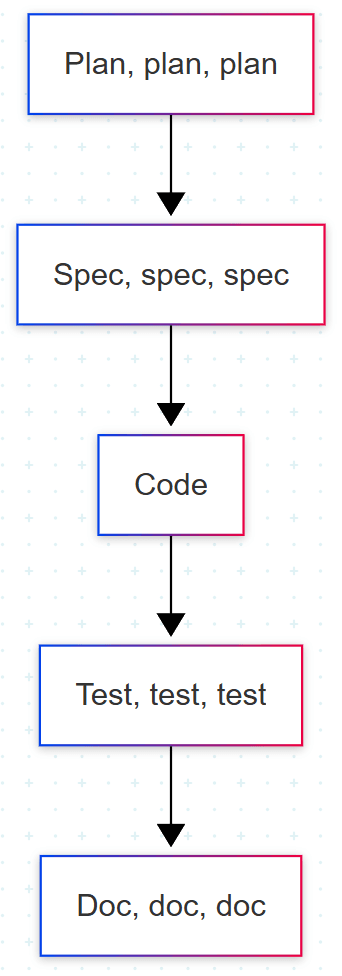
That is precisely why a structured development lifecycle matters more than ever. The discipline is to plan thoroughly before any code is written, write precise specifications that leave little room for ambiguity, treat the code generation step as just one part of a larger process, test rigorously against the original spec, and document everything so that intent and implementation stay tightly aligned.
- Plan, plan, plan
- Spec, spec, spec
- Code
- Test, test, test
- Doc, doc, doc
Harmonized Vocabulary
Establish a formal domain vocabulary and relentlessly iterate on naming conventions for all frontend and backend components to ensure consistency and semantic viability.
Optimize Token Allocation
Dedicate a significant portion (e.g., 50%) of your AI model's token allocation to non-coding tasks like planning and research for better outcomes.
External Model Planning
Conduct planning activities with AI models outside the IDE. Inject source code examples and read/annotate traces during this process.
Granular Iteration
Work with models at the class/function level, not entire modules. Iterate over code tasks to continuously refine model output.
Context Management
Summarize interactions to conserve context memory and build historical references. Condense library/tool documents for quick reference.