Pricing the Bad Year
How GreenOS-Fin turns CEA risk assessment into numbers a lender can read
Most risk assessment in agriculture ends as a document: a register of things that could go wrong, a heat map, a list of mitigations. Useful for compliance. Nearly useless for decisions — because none of it touches the pro-forma. The risk lives in one file, the financial model in another, and the two never meet.
In Controlled Environment Agriculture that separation is expensive, because CEA risk has a specific character that general-purpose frameworks miss.
What Makes CEA Risk Different
Three things. First, the events are discrete, not gradual. A disease outbreak, a pest infestation, a cooling failure — these either happen in a given year or they don't. Published research puts the five-year probability of a significant disease or pest event at 60-70% for a facility without formal integrated pest management. These are not tail risks. They are operating conditions.
Second, each event hits both sides of the ledger at once. A disease outbreak is not just lost revenue. It is a production halt while fixed costs continue, remediation labor, sanitation runs, and a quality downgrade that pushes product into lower-priced channels.
Third — the one almost everyone misses — the events compound. Disease response consumes emergency energy precisely when energy prices may be spiking. Treating them as independent risks, the way most Monte Carlo models do, systematically understates the bad year.
What the Numbers Say
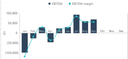
For the facility we modeled, the median Year 7 valuation without operational risk events is roughly $363M. With disease and temperature events properly modeled, roughly $296M — an 18% discount on the median, with the downside tail hit harder. That is not pessimism. It is the probability-weighted cost of events the industry data says are more likely than not — a cost that a base-case pro-forma silently assumes away.
Mitigation Becomes an Investment Decision
In the model, formal IPM protocols reduce the annual disease probability from roughly 18% to 6%. Flip that single toggle and the median valuation recovers toward the no-risk baseline. That difference, in dollars, is what IPM is worth — a valuation delta a CFO can weigh against the protocol's cost. The same logic prices backup cooling, redundant power, and staffing depth.
Why Lenders Should Care
CEA earned its credibility problem: too many pro-formas presented the good year as the expected year. Paradoxically, showing the 18% discount makes the business more financeable, not less. A borrower who can quantify the bad year has, by demonstration, thought harder than one who can't.
If your risk assessment can't move a number in your pro-forma, it isn't finished.
#CEA #RiskManagement #AgTech #FinancialModeling #MonteCarlo